
Crypto payments have moved beyond a niche use case, with public merchant directories now tracking tens of thousands of businesses that accept digital assets globally. Bitcoin remains the dominant payment cryptocurrency, while Ethereum, Litecoin, Bitcoin Cash, Dogecoin, and stablecoins also maintain a meaningful merchant presence.
The U.S. shows particularly strong adoption, driven heavily by consumer demand and simpler payment infrastructure. While regulatory uncertainty and price volatility remain operational barriers, automatic fiat conversion and merchant gateways are rapidly easing integration, expanding crypto acceptance from specialist merchants into mainstream commerce.
1. Merchant Adoption Moves Into the Mainstream
Crypto merchant acceptance is no longer limited to specialist businesses serving digital-asset users. Public directories now identify tens of thousands of locations where customers can pay with cryptocurrencies.
For example, BTC Map listed 23,051 Bitcoin-accepting merchants as of April 2026. Because this figure tracks Bitcoin specifically, it serves as a baseline indicator for publicly mapped locations rather than a total count of all crypto-accepting businesses. The overall market is considerably broader; multi-asset directories like Cryptwerk track acceptance across Bitcoin, Ethereum, Litecoin, Bitcoin Cash, Dogecoin, Tether, and other tokens.
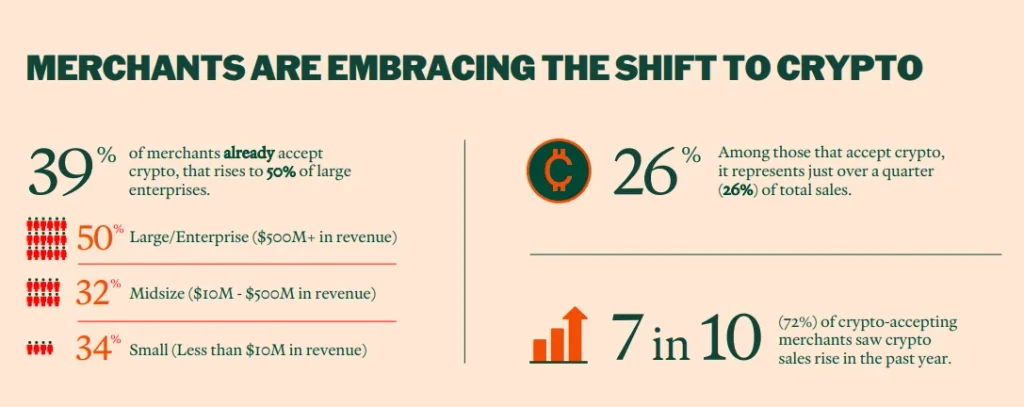
Survey data provides further evidence of this shift. A January 2026 PayPal/National Crypto Association (NCA) survey found that 39% of U.S. merchants already accept cryptocurrency at checkout. Adoption was highest among large enterprises (generating over $500 million in annual revenue) at 50%, compared to 34% among small businesses and 32% among midsize businesses.
Together, public directories (which track where crypto can be used) and merchant surveys (which track how many businesses report accepting it) show that crypto payments have moved well beyond isolated early adopters.
2. Customer Demand Is the Primary Catalyst
Merchant adoption is increasingly driven by customer interest rather than pure technical experimentation.
According to the PayPal/NCA survey, 88% of merchants receive customer inquiries about paying with crypto, with 69% reporting that customers want to use crypto at least once a month. Additionally, 79% of merchants agree that accepting crypto helps attract new customers..
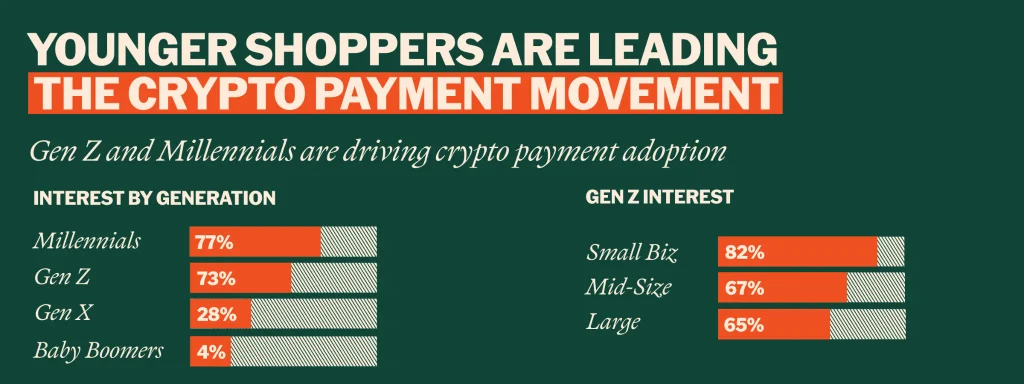
Demographics play a critical role in this demand:
- Millennials: 77% express interest in crypto payments.
- Gen Z & Younger Consumers: 73% express interest.
- Gen X: 28% express interest.
- Baby Boomers: 4% express interest.
This generational pull is particularly strong for smaller retailers: 82% of small businesses report receiving crypto payment inquiries from Gen Z customers, compared to 67% of midsize and 65% of large enterprises.
Overall, 84% of surveyed merchants expect crypto payments to become common within five years, demonstrating that businesses increasingly view digital assets as a response to evolving customer preferences.
3. Hospitality and Retail Lead Acceptance
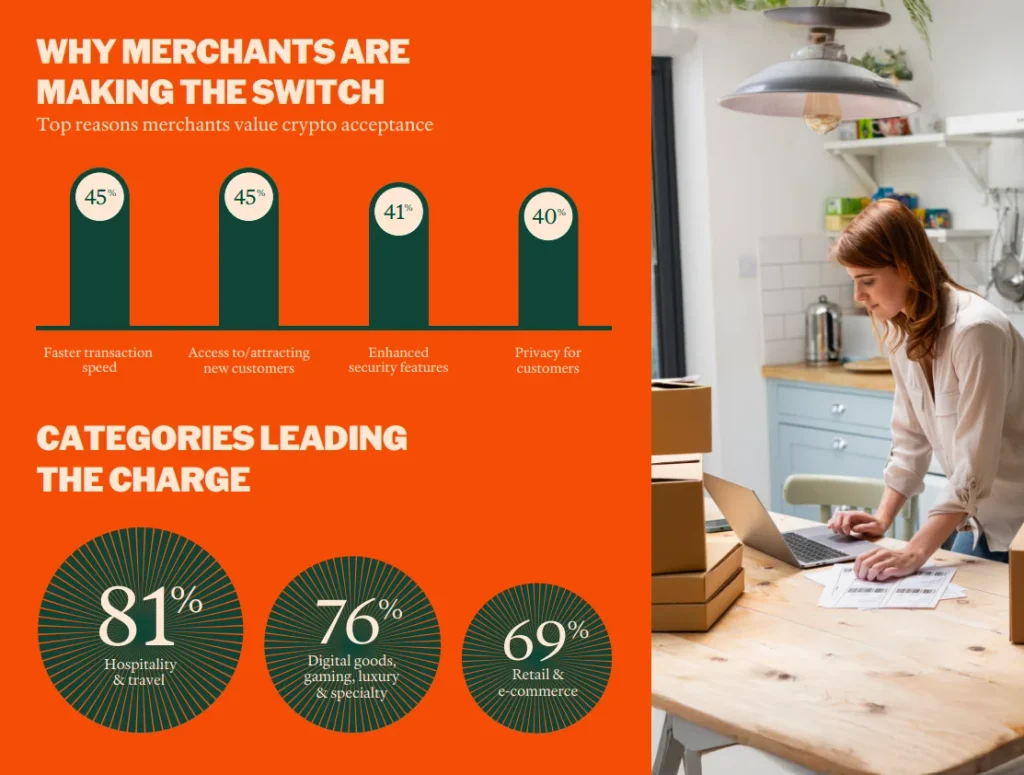
Crypto acceptance varies significantly by industry. Sectors with high cross-border activity or native digital operations lead the transition.
Travel businesses frequently process international payments, digital and gaming brands operate in online-native environments, and e-commerce platforms can easily integrate payment gateways into existing digital checkouts.
Geographically, acceptance is concentrated in developed crypto markets but spans more than 140 countries.
While the U.S., U.K., and Germany lead in absolute merchant counts, countries like Switzerland and Slovenia exhibit a high density of physical locations per business, reflecting multi-location network integrations.
4. Bitcoin Remains the Merchant Leader
Bitcoin maintains a clear lead over alternative assets in merchant footprint.
Bitcoin’s lead is substantial. Its merchant rating is more than 35 percentage points above Ethereum, while the number of listed Bitcoin merchants is also significantly higher.
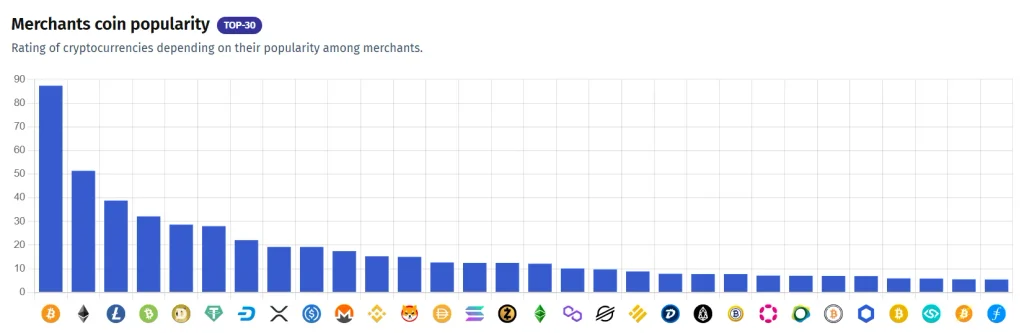
Cryptwerk’s dedicated Bitcoin analytics page currently records more than 7,100 BTC merchants and 205 payment gateways.
Ethereum remains the second-largest asset by merchant presence, with more than 4,100 listed merchants. Litecoin also maintains a substantial merchant footprint at more than 3,100 businesses.
Stablecoins are increasingly relevant because they address one of the biggest problems associated with merchant crypto acceptance: price volatility.
Tether appears among Cryptwerk’s six most widely accepted cryptocurrencies, while USDC also has more than 1,500 listed merchants. This provides evidence that merchant acceptance is gradually extending beyond purely volatile assets toward payment-oriented digital currencies.
5. Payment Infrastructure Is Reducing Friction
Most traditional merchants do not want to manage private keys, monitor raw blockchain transactions, or hold volatile assets on their balance sheets. Payment processors and gateways solve this by abstracting backend complexity.
Key operational mechanisms include:
- Automatic Fiat Conversion: Payment processors immediately convert received crypto into local fiat currency and transfer the funds directly to the merchant’s bank account, shielding the business from market swings.
- Unified Checkout Integration: Gateways embed crypto options directly into standard point-of-sale (POS) systems and e-commerce carts alongside credit card options.
Beyond convenience, merchants cite concrete business benefits for adopting crypto payment rails: 45% highlight faster transaction speeds, 45% point to new customer acquisition, 41% report enhanced security, and 40% value greater privacy.
6. Volatility, Regulation, and Operations
Despite positive growth, structural friction remains:
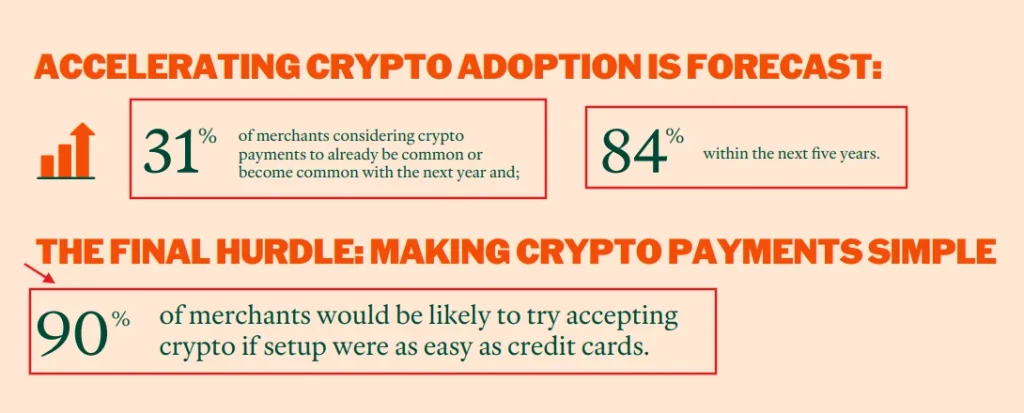
In fact, 90% of surveyed merchants state they would accept crypto if the experience matched traditional card payments and setup were equally simple. Simplicity remains the critical variable for mass adoption.
To manage these operational risks, adapting merchants are standardizing around key best practices:
- Partnering with secure payment gateways featuring 2FA and encryption.
- Utilizing auto-conversion to fiat for treasury stability.
- Training staff to identify payment errors and maintaining clear refund logs.
- Restricting accepted payment methods to top-tier cryptocurrencies and stablecoins.
Market Outlook
The primary question around crypto merchant adoption has shifted from whether businesses can accept digital assets to how easily they can integrate them.
Growth is accelerating across three complementary layers: expanding merchant integration, rising demand among younger demographics, and maturing payment gateway infrastructure. As checkout tools continue to mirror traditional credit card simplicity, crypto acceptance is solidifying its place as a standard component of global commerce.